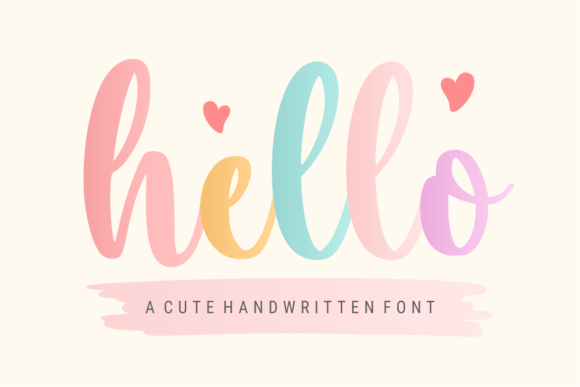
More Than a Greeting: The Versatile Charm of the Hello Font
There’s a certain magic in a handwritten note. It feels personal, immediate, and infused with a human touch that a standard, blocky typeface simply can’t replicate. In the world of digital design, capturing that authentic, handwritten feeling is a powerful tool. This is where a premium font like Hello enters the conversation. It’s not just a collection of letters; it’s a stylistic voice, a delicate and cute handwritten font that carries a distinct personality. Its charm lies in its ability to feel both playful and elegant, making it a surprisingly versatile design asset for creators across many fields.
Visually, Hello is defined by its gentle curves and a flowing, connected script that mimics natural handwriting. It avoids the chaotic, overly casual look of some script fonts, instead offering a clean and stylish aesthetic. The letterforms are consistent yet have enough organic variation to feel authentic. This balance is key to its broad appeal. It doesn’t scream for attention like a bold display font, but it confidently draws the eye with its warmth and approachability. Think of it as the typographic equivalent of a friendly smile—it’s inviting and sets a positive tone immediately.
Finding Its Place: From Wedding Invitations to Social Media Feeds
The true strength of a font like Hello is its chameleon-like ability to adapt to different projects while maintaining its core identity. Its most natural habitat is in celebratory and personal design. For wedding themes, it’s a perfect fit for invitations, save-the-dates, and thank you cards, where it conveys romance and intimacy. Similarly, it shines in greeting cards for birthdays, holidays, and other occasions, adding a heartfelt, custom-made feel that off-the-shelf cards lack.
Beyond personal stationery, this creative font has significant commercial applications. Small business owners and entrepreneurs can leverage it for brand identity, particularly for brands that want to project a friendly, artisanal, or approachable image. Imagine a boutique bakery using Hello on its packaging, a local florist’s logo, or the branding for a handcrafted soap company. It instantly communicates a level of care and personality. In packaging design, it can be used for product names or taglines to create a softer, more personal shelf presence.
In the digital realm, its utility is just as strong. For web design, it can be a fantastic choice for hero section headings, call-to-action buttons, or pull quotes to break up long-form content and add visual interest. However, its true power online is often seen in social media graphics. A well-placed quote, a promotional announcement, or a simple overlay on a lifestyle image becomes instantly more engaging and shareable when set in a stylish handwritten font. It cuts through the visual noise of a social feed with a personal touch that feels less corporate and more human.
The Art of the Pair: Using Hello with Intention
While Hello is a star player, no font is an island. A crucial skill for any designer or creator is mastering font pairing. The goal is to create a visual hierarchy where the fonts complement each other, not compete. Because Hello is a script font with a strong personality, it pairs best with a neutral, highly legible counterpart. A clean sans serif font is often the ideal partner. Use Hello for a headline or a key phrase to inject personality, and then use the sans serif for body text to ensure maximum readability and a professional structure. This contrast creates a dynamic and balanced layout.
You can also create an interesting pairing with a classic serif font. This combination can feel more traditional and sophisticated, suitable for editorial design or high-end brand materials. The key is to test your pairings rigorously. Place them side-by-side in a mockup. Does the headline (Hello) stand out appropriately? Is the body text easy to read at a small size? Does the overall combination support the message and the brand perception you’re trying to build? A great pairing enhances audience engagement because it makes the content easier and more pleasant to consume.
A Practical Guide to Working with This Typeface
When you decide to incorporate Hello into your toolkit, a few practical considerations will ensure you get the most out of it. First, always review the full character set and any included styles. A quality commercial font often comes with alternates, ligatures, or different weights that can add even more versatility and a custom feel to your work.
Second, context is everything. Evaluate the fit for your specific project. While it’s perfect for a birthday party flyer, it might not be the right choice for the body text of a legal document. Its strength is in headlines, logos, short phrases, and decorative elements where its personality can shine without compromising clarity. For longer blocks of text, always prioritize a more traditional typeface for the main copy.
Finally, pay close attention to licensing. If you’re a designer working on a project for a client, a blogger selling merchandise, or a publisher creating a book cover, you need to ensure you have the correct commercial license. This protects both you and the font creator and is a non-negotiable part of professional practice. By treating Hello as a strategic design asset rather than just a pretty style, you can leverage its unique charm to create work that is not only beautiful but also effective, memorable, and perfectly aligned with your creative goals.