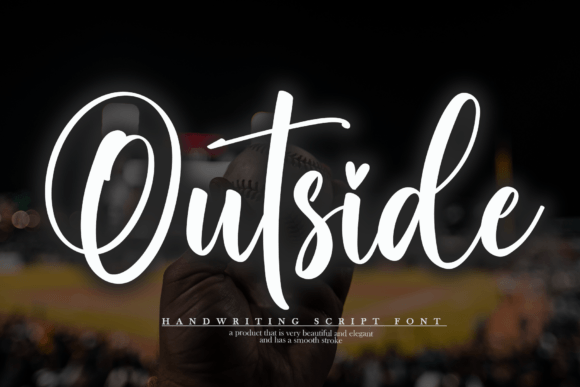
Outside: The Handwritten Font That Feels Like a Friendly Wave
Why This Typeface Feels Like a Deep Breath
There’s a reason certain designs just feel right. It’s often not the big, flashy element, but the subtle texture, the human touch that makes you pause and lean in. In a world of rigid geometric sans serifs and formal serifs, a font like Outside acts as a palate cleanser. It’s not trying to be the loudest voice in the room; it’s the one that makes you feel at ease. This is a premium font that understands its role perfectly: to inject personality, warmth, and approachability into any project it touches.
Visualize the strokes. They aren’t the perfectly uniform, machine-made lines you’d find in a standard web font. Instead, they have a gentle, organic rhythm. There’s a slight bounce to the baseline, a subtle variation in thickness that mimics the natural pressure of a pen held loosely in the hand. It’s a modern typography take on casual calligraphy, but with a legibility that many script fonts lack. This isn’t a chaotic, overly flourished display font that sacrifices clarity for style. It’s a workhorse for creatives who want their work to feel personal, not pretentious.
From Instagram Grids to Product Packaging: Where Outside Shines
The true test of a creative font is its versatility. Does it belong only on a wedding invitation, or can it hold its own in a crowded social media feed? Outside proves its worth across a surprisingly broad range of applications. For content creators and social media managers, it’s a secret weapon for making static graphics feel dynamic and relatable. Imagine it overlaying a photo on Instagram, delivering a quote that feels handwritten just for the viewer. It cuts through the cold, algorithmic feel of most digital content.
For entrepreneurs and small business owners building a brand identity, this typeface offers a distinct voice. It’s perfect for a bakery’s logo, a boutique coffee shop’s menu, or the headers on a lifestyle blog. It communicates that a real person is behind the business, someone who cares about the craft. In packaging design, it can transform a simple label into something that feels artisanal and thoughtful. Paired with a clean sans serif for body text, Outside creates a beautiful visual hierarchy that guides the eye and establishes a friendly, trustworthy tone.
Pairing for Professional Impact
A font rarely works alone. The art of font pairing is about creating a conversation between typefaces. Outside’s casual, handwritten nature makes it an ideal partner for more structured, neutral fonts. Try combining it with a classic serif like Garamond for a design that feels both elegant and approachable—a great fit for editorial design in a high-end lifestyle magazine. Alternatively, pairing it with a simple, geometric sans serif like Futura or Open Sans creates a clean, modern contrast. This combination works exceptionally well for web design, where the handwritten font can be used for impactful headlines or calls to action, while the sans serif ensures readability for longer paragraphs.
A Practical Guide to Using Outside in Your Projects
Before you dive in, take a moment to consider your project’s specific needs. Outside is a display font at its heart. This means it’s designed to grab attention in headlines, logos, and short bursts of text. It’s not the right choice for setting a 300-page novel or a dense technical manual. Its strength is in its charm, and that charm is most effective when used strategically.
When evaluating its fit, ask yourself: What is the core emotion I want to convey? If the answer is warmth, creativity, friendliness, or authenticity, you’re on the right track. Test it out. Mock up your logo, your social media post, or your product label. How does it look at different sizes? A key advantage of a well-crafted handwritten font like this is its scalability; the letterforms remain distinct and readable even when used small on a business card or large on a poster.
Understanding the Included Styles and Licensing
A complete font package often includes more than just the base style. Check for Outside’s included character sets. Does it offer ligatures (special combined characters like ‘fl’ or ‘tt’)? Does it have stylistic alternates—different versions of certain letters that you can swap in for more visual variety? These features are what separate a basic free font from a professional commercial font. They give you the control to fine-tune the typography and make it truly unique to your project.
Finally, and most importantly, consider the licensing. For any project that will be used commercially—whether it’s a client’s logo, a product you sell, or marketing materials for your business—you need to ensure you have the correct license. A reputable premium font like Outside will come with a clear license that outlines permitted uses. This isn’t just a legal formality; it’s an ethical practice that supports the designers who create these essential design assets. Using a font within its licensed terms is a mark of professionalism.
In the end, choosing a typeface is about finding a voice. Outside offers a voice that is confident without being loud, friendly without being unprofessional, and personal without being sloppy. It’s a tool for designers, marketers, and creators who understand that the smallest details often make the biggest connection. It turns a simple idea into a piece that feels genuinely crafted, and that’s a powerful thing in any medium.